

Table of Contents
Why chest fat sticks around (and what actually works)
If you’re reading this, you’ve probably spent some time staring at your chest in the mirror, wondering why it doesn’t look the way you want it to. Maybe you’ve tried push-ups. Maybe you’ve cut carbs for a few weeks. Maybe you Googled “how to lose chest fat” at 2 a.m. and ended up here.
I get it. Excess chest fat is one of the most common complaints Dr. Moeinolmolki hears from male patients at his Los Angeles practice. Some of them have been dealing with it for years. The good news is that for many men, a combination of the right exercises, dietary changes, and consistent effort can make a real difference. The less comfortable truth is that for some men, the problem isn’t fat at all.
Let’s start with what you can control.
Spot reduction is a myth
Before we get into specific exercises, I need to be honest about something the fitness industry doesn’t always make clear. You cannot selectively burn fat from your chest by doing chest exercises. That’s not how fat loss works. Your body decides where it pulls fat from based on genetics, hormones, and overall body composition. Chest exercises build muscle underneath the fat, which can improve shape and definition over time, but only if you’re also losing fat through a caloric deficit.
Think of it this way: doing 200 push-ups a day with a layer of fat over your pecs is like putting a nice frame on a painting and then covering it with a blanket. The frame is there, but nobody can see it.
So the real strategy for getting rid of chest fat has two parts. Build the muscle. Lose the fat. They happen at the same time, but through different mechanisms.
Chest exercises that actually build muscle
These movements target the pectoralis major and minor. Consistency matters more than intensity here, a principle supported by the American Council on Exercise (ACE). Pick three or four of these and do them twice a week.
Barbell bench press
This is the foundation. Lie flat on a bench, grip the bar slightly wider than shoulder width, and lower it to your mid-chest. Press it back up without locking your elbows completely. Start with 4 sets of 8 to 10 reps at a weight where the last two reps feel difficult but your form stays clean. If you’re new to this, use a spotter or a Smith machine until you’re comfortable.
Incline dumbbell press
Set the bench to about 30 to 45 degrees. This targets the upper chest, which gives a more defined look and helps reduce the appearance of sagging. Use dumbbells rather than a barbell so each side works independently. Try 3 sets of 10 to 12 reps.
Cable flies
Set the pulleys to about shoulder height. Step forward slightly so there’s tension on the cables, then bring your hands together in front of your chest in a hugging motion. Keep a slight bend in your elbows throughout. This isolates the chest more than pressing movements do. Go for 3 sets of 12 to 15 reps with a weight you can control, not swing.
Push-ups (weighted or banded)
Bodyweight push-ups are fine for beginners, but if you can do more than 20 in a row, they’re not doing much for muscle growth anymore. Add a weight plate on your back, use a resistance band across your shoulders, or elevate your feet on a bench. Aim for 3 sets of 12 to 15 reps. Slow the movement down, taking about 2 seconds on the way down.
Dips
Lean your torso forward slightly during the movement to shift emphasis to your chest instead of your triceps. Lower yourself until your upper arms are roughly parallel to the floor, then press back up. If bodyweight dips are too easy, hold a dumbbell between your feet or use a dip belt. Do 3 sets of 8 to 12 reps.
Cardio for fat loss: HIIT vs. steady-state
Both work. The research on this is pretty clear at this point. High-intensity interval training (HIIT) burns more calories per minute and creates an afterburn effect called excess post-exercise oxygen consumption (EPOC), where your metabolism stays elevated for hours after the workout. A typical HIIT session might be 20 minutes of 30-second sprints followed by 60 seconds of walking, repeated 8 to 10 times.
Steady-state cardio, like jogging at a conversational pace for 30 to 45 minutes, burns fewer calories per session but is easier to recover from and easier to sustain long term. Most of my patients who successfully lose chest fat do a mix of both: two HIIT sessions and two to three steady-state sessions per week.
The one thing I’d emphasize is that you don’t need to live on a treadmill. A 200- to 400-calorie deficit per day combined with resistance training will get most men where they need to be within 3 to 6 months.
Diet adjustments that move the needle
I’m not going to prescribe a specific meal plan. What I will say is that three dietary factors come up repeatedly with patients who struggle with chest fat.
Caloric deficit. You need to eat fewer calories than you burn. For most men, that means eating about 300 to 500 calories below your maintenance level. Use a TDEE calculator online to estimate your maintenance calories, then subtract. Track your food for at least two weeks to get a sense of where you actually stand. Most people underestimate their intake by 20 to 40%.
Protein intake. Higher protein diets preserve muscle while you’re losing fat. Aim for about 0.7 to 1 gram of protein per pound of body weight per day. For a 200-pound man, that’s 140 to 200 grams. Chicken, fish, eggs, Greek yogurt, and whey protein are the usual suspects. Without adequate protein, your body will break down muscle along with fat, and you’ll end up lighter but not leaner.
Alcohol. This one surprises people. Regular alcohol consumption, especially beer and spirits in large quantities, can raise estrogen levels in men. Estrogen promotes fat storage in the chest area specifically. I’ve had patients who dropped two to three drinks per week and noticed visible changes within a couple of months. I’m not saying you can never have a beer. But if you’re drinking four or five nights a week and wondering why your chest won’t lean out, that’s worth looking at.
When your chest fat isn’t fat at all
This is the part of the article I really want you to read. Because every week in his practice, Dr. Moeinolmolki sees men who have done everything right. They lift. They eat well. They’ve lost 30, 40, sometimes 50 pounds. And their chest still doesn’t look the way they want it to.
The reason, in many cases, is that they don’t have pseudogynecomastia (excess chest fat). They have true gynecomastia, which is the growth of actual glandular breast tissue beneath the nipple.
Here’s the difference. Fat is soft and distributed across the chest. It responds to diet and exercise. Glandular tissue is firm, sometimes rubbery, and it sits directly behind the areola. You can often feel it as a disc-shaped mass. No amount of bench pressing will shrink it because it’s not fat. It’s tissue, and it behaves differently.
The pinch test
There’s a simple self-check you can do at home. Stand in front of a mirror and pinch the area directly behind your nipple between your thumb and index finger. If you feel a firm, rubbery lump that’s distinct from the surrounding soft tissue, that’s likely glandular tissue. If the whole area feels uniformly soft, it’s more likely fat. This isn’t a diagnosis. But it’s a useful starting point. I’ve written more about this here.
The distinction between gynecomastia and chest fat matters because the treatment is completely different. Fat responds to lifestyle changes. Glandular tissue does not. It requires surgical excision, often combined with liposuction, to remove.
What I see in my practice
Dr. Moeinolmolki can think of dozens of patients who came to him after years of frustration. One man had been lifting six days a week for three years. His body fat was around 12%. His arms, shoulders, and back looked great. But he still had puffy nipples and a rounded chest contour that made him avoid pools and fitted shirts. An ultrasound confirmed glandular tissue on both sides. After a gynecomastia procedure, his chest finally matched the rest of his body.
That story is common. If you’ve been working hard and the results just aren’t showing in your chest, it may not be a discipline problem. It may be a tissue problem.
When to talk to a doctor
Consider seeing a specialist if any of these apply to you:
- You’ve been in a caloric deficit and training consistently for 6 months or more with no improvement in your chest
- You can feel a firm lump behind one or both nipples
- Your nipples are puffy or protrude more than you’d expect given your body fat level
- You had breast tissue growth during puberty that never fully went away
- You’re taking medications known to cause gynecomastia (finasteride, spironolactone, certain antipsychotics)
Dr. Babak Moeinolmolki, MD, FACS, is dual board-certified by the American Board of Cosmetic Surgery (ABCS) and American Board of General Surgery. He specializes in gynecomastia surgery and body contouring using VASER liposuction at his practice in Los Angeles. If you’re not sure whether what you’re dealing with is fat or glandular tissue, a physical exam can give you a clear answer in about 10 minutes. Learn about the complete gynecomastia surgery process if glandular tissue is found.
Frequently asked questions
Can I lose chest fat by just doing push-ups every day?
Push-ups will strengthen your pectoral muscles, but they won’t specifically burn fat from your chest. Fat loss happens through a caloric deficit, meaning you need to burn more calories than you consume overall. Push-ups alone don’t burn enough calories to create that deficit. Combine them with full-body resistance training, cardio, and dietary changes for actual results.
How long does it take to lose chest fat?
It depends on your starting body fat percentage, your diet, and how consistent you are. Most men who maintain a 300- to 500-calorie daily deficit while training regularly start noticing changes in their chest within 8 to 12 weeks. Significant transformation typically takes 4 to 6 months. If you’re not seeing progress after 6 months of consistent effort, the issue might not be fat.
Does alcohol really affect chest fat?
Yes. Alcohol increases aromatase activity, which is the enzyme that converts testosterone to estrogen. Higher estrogen levels promote fat storage in the chest specifically. Heavy drinking also adds empty calories and disrupts sleep, both of which make fat loss harder. You don’t have to quit entirely, but cutting back to two or three drinks per week can help.
How do I know if I have gynecomastia or just chest fat?
The simplest way to check at home is the pinch test. Pinch the tissue directly behind your nipple. If you feel a firm, disc-like mass, that’s likely glandular tissue (gynecomastia). If it’s all soft and uniform, it’s probably fat. An ultrasound or physical exam by a specialist can confirm the diagnosis.
Will losing weight get rid of gynecomastia?
It depends on the type. If you have pseudogynecomastia, which is caused by excess fat, then yes, weight loss can improve or resolve it. If you have true gynecomastia with glandular tissue, losing weight won’t remove that tissue. Many men lose significant weight and are frustrated that their chest still looks the same. That’s usually a sign of glandular involvement that requires surgical treatment.
What exercises should I avoid if I have chest fat?
There aren’t exercises you need to avoid, but some are less effective than others. Isolation movements on machines with very light weight won’t build enough muscle to make a visible difference. Focus on compound movements like bench press, dips, and push-ups at challenging weights. And don’t skip the cardio and diet components, because those are what actually reduce the fat layer.
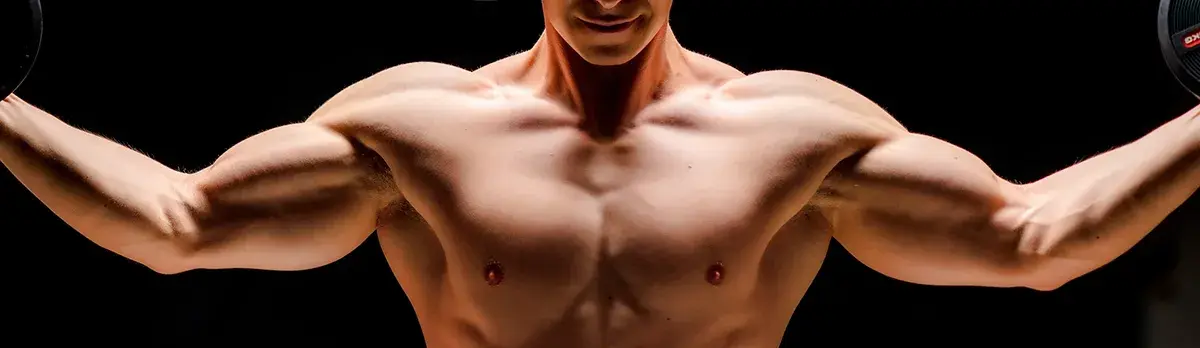
* Illustrative images on this page are models, not actual patients. Real patient results are shown in our Before & After gallery.

Dr.Babak Moeinolmolki
LA Cosmetic Surgeon Dr. Moein is board-certified by the American Board of General Surgery.