


Table of Contents
You made it through gynecomastia surgery. The chest looks better already, even with the swelling. Then, a few weeks later, you notice something that was not there before: a hard area under the skin. Maybe it feels like a marble or a firm ridge. Maybe the whole treated area feels stiff and unyielding. Your first thought is that something went wrong.
Take a breath. In the vast majority of cases, what you are feeling is scar tissue, and it is a completely normal part of the healing process. I am Dr. Babak Moeinolmolki, dual board-certified by the American Board of Cosmetic Surgery (ABCS) and the American Board of General Surgery, and I tell every one of my patients to expect this phase. It still catches people off guard, though, which is why I want to explain what happens under the skin after surgery, what is normal, what is not, and exactly how to manage it.
Why Scar Tissue Forms After Gynecomastia Surgery
Your body treats any surgical site as a wound that needs to be repaired. The moment tissue is cut, removed, or disrupted, your immune system goes to work. White blood cells flood the area to clean up damaged cells and prevent infection. Fibroblasts follow behind them, laying down collagen fibers to rebuild the structural framework of the tissue.
This collagen is what creates scar tissue. It is thicker and less flexible than the original tissue it replaces. During the early weeks of healing, the body tends to overproduce collagen. It is as if the repair crew shows up and uses too much concrete. The result is firmness, sometimes quite pronounced, in the surgical area.
After gynecomastia surgery, scar tissue can form in the area where glandular tissue was excised, along the tracks where liposuction was performed, and at the incision sites themselves. All three locations are prone to the same collagen-overproduction process.
The Timeline of Scar Tissue Formation
Understanding the timeline helps a lot because it lets you know whether what you are feeling is on schedule or genuinely unusual.
Week 1: Swelling dominates. The chest is puffy and tender. Scar tissue has not had time to form yet. Any firmness at this stage is from surgical swelling and possibly a mild hematoma, both of which are expected.
Weeks 2 through 6: This is when scar tissue starts to become noticeable. The initial swelling begins to go down, but in its place you feel firm, sometimes hard, areas under the skin. This is the collagen buildup. Many patients describe it as feeling like they still have breast tissue in there, which understandably creates anxiety. Weeks 3 through 5 tend to be the peak of this firmness.
Months 2 through 3: Scar tissue typically reaches its maximum density around the three-month mark. The chest may feel hard in spots, and the contour may look a bit uneven. This is still within the normal healing window.
Months 4 through 12: The body gradually remodels the scar tissue. Collagen fibers reorganize, soften, and thin out. The firmness decreases month by month. Most patients feel a significant difference between what their chest felt like at three months and what it feels like at nine or twelve months.
Beyond 12 months: For the large majority of patients, scar tissue has fully matured and softened. The chest feels natural. A small number of patients retain some residual firmness, but it is usually mild and not visible from the outside.
Normal Scar Tissue vs. Something to Worry About
It is natural to be hyperaware of every sensation in your chest after surgery. Here is how to tell the difference between routine scar tissue and a problem that needs attention.
Normal scar tissue feels firm and evenly distributed across the treated area. It does not grow noticeably from week to week after the first month. Any tenderness is mild and does not get worse over time. The skin over it looks normal in color and temperature.
Signs that something else may be going on:
- A lump that is growing rapidly or appeared suddenly after a period of improvement
- Pain that increases rather than gradually decreasing
- Redness or warmth over a specific area, which could indicate infection or a seroma (fluid collection)
- Asymmetry that is getting worse rather than better
- Fever, chills, or drainage from the incision site
If any of these apply, contact your surgeon. A seroma (a collection of fluid under the skin) can feel like a firm or fluctuant lump and sometimes requires drainage. A hematoma (blood collection) can feel hard and may cause discoloration of the overlying skin. Infection is less common but requires prompt treatment with antibiotics.
How to Treat and Manage Scar Tissue
Massage
Scar tissue massage is the single most effective tool you have for managing post-surgical firmness. I give every patient a detailed massage protocol. The basic technique involves firm, circular motions applied directly over the areas of firmness, using your fingertips or the flat of your hand.
When to start depends on your healing progress. I typically clear patients to begin gentle massage around two to four weeks after surgery. Starting too early can disrupt the healing tissue. Starting too late means the scar tissue has more time to organize and harden.
The recommended routine: five to ten minutes of firm circular massage, twice daily. Consistency matters more than intensity. A patient who massages faithfully twice a day for three months will see far better results than someone who does an aggressive session once a week.
Compression Garments
The compression garment you wear after surgery does more than reduce swelling. It applies steady, even pressure that helps mold the healing tissue and prevents fluid accumulation. I ask patients to wear their compression garment as directed in the aftercare instructions, typically for four to six weeks. Some patients benefit from wearing it longer if they have significant scar tissue formation.
Ultrasound Therapy
Therapeutic ultrasound, administered by a physical therapist, can help break down adhesions and soften dense scar tissue. The sound waves increase blood flow to the area and promote collagen remodeling. This is not the same as the ultrasound used for diagnostic imaging. It is a treatment modality that some patients find helpful, particularly if scar tissue is stubborn or localized in a specific area.
Steroid Injections
For patients who develop keloid or hypertrophic scarring at the incision sites, corticosteroid injections can flatten and soften the scar. I typically use triamcinolone, injected directly into the thickened scar tissue. This is not needed for routine internal scar tissue formation, only for visible, raised scarring at the skin surface. Keloid and hypertrophic scars are more common in patients with darker skin tones and those with a personal or family history of keloids.
Revision Surgery
Revision surgery for scar tissue after gynecomastia surgery is rarely needed. I reserve it for cases where scar tissue has created a visible deformity or a palpable irregularity that has not responded to six to twelve months of conservative management. In my experience, fewer than 5% of patients ever require a revision for scar-tissue-related concerns.
What I Do to Minimize Scar Tissue in My Practice
Prevention starts in the operating room. I use techniques that minimize tissue trauma, which reduces the inflammatory response that triggers excessive collagen production. VASER liposuction, which I use in most gynecomastia cases, emulsifies fat with ultrasound energy before removal, causing less mechanical disruption than traditional liposuction.
After surgery, the combination of compression garments, early massage when cleared, and regular follow-up visits allows me to monitor each patient’s healing and intervene early if scar tissue is becoming problematic. I see patients at regular intervals during the first year. If I notice concerning scar tissue formation at a follow-up visit, I can adjust the management plan immediately rather than waiting for the patient to report a problem.
When to Contact Your Surgeon
If you are within the first three months after surgery and you feel firmness in your chest, it is almost certainly normal scar tissue. Follow your massage protocol, wear your compression garment, and be patient. If you are beyond six months and the firmness has not improved, or if you have any of the warning signs I described above, schedule a follow-up with your surgeon.
For patients of mine, I am available for follow-up concerns at any point during recovery. For those who had surgery elsewhere and are unhappy with scar tissue or other issues, I also offer revision consultations.
Frequently Asked Questions
Is it normal to feel a hard lump after gynecomastia surgery?
Yes. Hard lumps and firm areas are a normal part of the healing process. They are caused by collagen buildup as your body repairs the surgical site. This firmness typically peaks around two to three months after surgery and then gradually softens over the following six to nine months.
How long does scar tissue last after gynecomastia surgery?
Scar tissue begins to soften around three to four months after surgery and continues to improve for up to a year. Most patients feel that their chest has reached its final softness by twelve months. A small percentage of patients retain mild residual firmness that is not noticeable from the outside.
Can massage really help with scar tissue?
Massage is the most effective non-surgical treatment for post-operative scar tissue. Firm, consistent massage breaks up collagen adhesions and promotes softer, more pliable tissue. The key is consistency: five to ten minutes twice daily produces better results than occasional aggressive sessions.
When should I worry about a lump after gyno surgery?
Contact your surgeon if a lump appears suddenly, grows rapidly, is accompanied by increasing pain, causes redness or warmth over the skin, or if you develop a fever. These could indicate a seroma, hematoma, or infection rather than normal scar tissue.
Does scar tissue after gynecomastia surgery affect the final result?
In the short term, scar tissue can make the chest look and feel uneven. In the long term, once the scar tissue has fully matured and softened (usually by twelve months), it does not affect the cosmetic result for the vast majority of patients.
Can scar tissue make it look like gynecomastia came back?
Yes, this is a common concern. The firmness and sometimes the visible fullness caused by scar tissue in the first few months after surgery can mimic the appearance of residual breast tissue. This is almost always temporary. As scar tissue remodels and softens, the contour improves and the chest flattens out to its final shape.
* Illustrative images on this page are models, not actual patients. Real patient results are shown in our Before & After gallery.
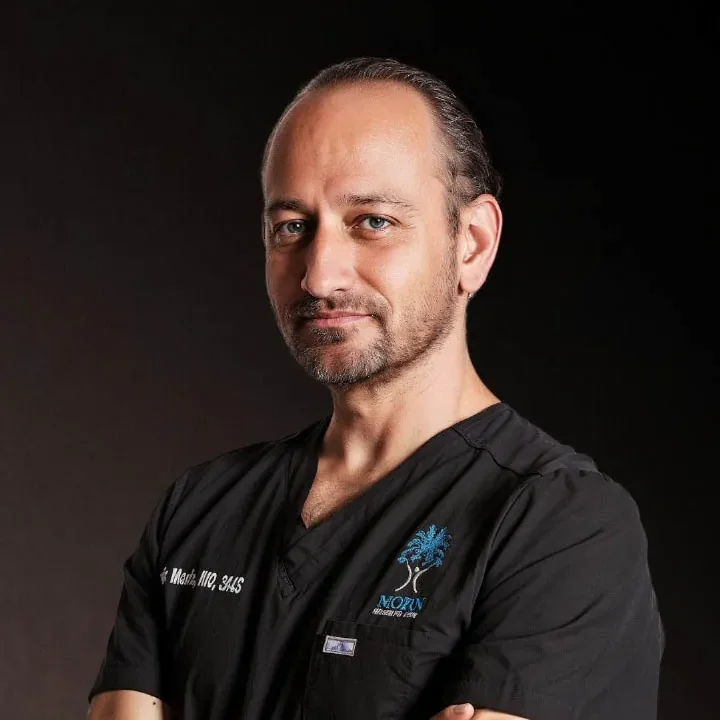
Dr.Babak Moeinolmolki
LA Cosmetic Surgeon Dr. Moein is board-certified by the American Board of General Surgery.