


Table of Contents
“Will my insurance pay for this?” It is one of the first questions men ask about gynecomastia surgery, and the honest answer is: usually not — but not never. The difference between a denial and an approval comes down to documentation, diagnosis, and understanding exactly what insurers are looking for. Having guided many patients through this process (and watched plenty arrive after a denial elsewhere), here is how coverage actually works in 2026.
Why Insurers Call It Cosmetic — and When They’re Wrong
Most policies classify gynecomastia surgery as cosmetic by default, because for most adult men the condition is benign and the motivation is appearance. But “cosmetic by default” is not “cosmetic always.” Insurers themselves publish medical-necessity criteria under which male breast reduction becomes a covered reconstructive procedure. The burden of proof sits entirely on you and your medical team.
What Actually Qualifies as Medically Necessary
Criteria vary by carrier, but the recurring requirements look like this:
- True glandular tissue, not fat. Insurers cover gland pathology, not pseudogynecomastia. Physical exam findings, and sometimes imaging, must document a palpable glandular component — where your case sits on the gynecomastia grading scale matters here.
- Documented pain or tenderness (mastalgia) persisting despite conservative management, noted across multiple visits.
- Persistence beyond adolescence or beyond a defined duration — typically more than one to two years, ruling out self-resolving pubertal gynecomastia.
- An underlying-cause workup. Labs excluding treatable hormonal disease, and documentation that contributing medications were reviewed. The Mayo Clinic outlines this workup — endocrine causes, medication triggers, and when observation is appropriate.
- Photographic documentation and, for some carriers, a minimum grade of severity (often Simon grade II or higher).
- Adolescent cases with significant gland, psychological documentation, and persistence get approved more often than adult cosmetic-pattern cases.
Miss one element and the claim usually dies in review. This is why “my doctor said it’s medically necessary” is not enough — the chart has to prove it against the carrier’s written policy.
What Insurance Will Not Cover
Liposuction-only correction of pseudogynecomastia is essentially never covered — fat removal is cosmetic in every carrier’s book. The same goes for cases motivated by contour alone, however legitimate that motivation is. And be aware of a practical trade-off: surgeons operating under insurance contracts are constrained in technique and setting; a covered periareolar excision at a hospital may not include the liposuction contouring and skin refinement that produce the result you actually want. Some of my revision patients come from exactly that scenario — covered surgery, disappointing contour. The American Society of Plastic Surgeons is explicit that insurance coverage for this procedure is the exception, not the rule.
How to Actually Pursue Coverage — A Realistic Playbook
- Get your carrier’s written policy for “gynecomastia surgery” or “reduction mammaplasty, male” — every major insurer publishes medical-policy bulletins. Read the exact criteria.
- Build the paper trail: primary-care or endocrinology visits documenting pain, duration, failed conservative management, labs, and medication review — over months, not in one visit.
- Request pre-authorization with photos, exam findings, and a letter of medical necessity keyed to the policy’s own language.
- Appeal denials. First-level appeals with better documentation succeed more often than most patients expect; independent external review is your final lever.
- Run the math either way. Between deductibles, coinsurance, and facility restrictions, covered surgery is not free — and self-pay pricing is more accessible than most men assume. Compare against our 2026 Los Angeles cost guide before deciding the paperwork war is worth it.
Frequently Asked Questions
Is gynecomastia surgery ever covered by insurance?
Yes, but only when it meets your carrier’s medical-necessity criteria: documented glandular tissue, persistent pain or tenderness, duration beyond one to two years, a completed workup excluding treatable causes, and usually a minimum severity grade. Purely cosmetic cases — most adult cases — are not covered.
Does insurance cover gynecomastia surgery for teenagers?
Adolescent cases have the strongest approval odds when the gynecomastia is severe, has persisted beyond expected pubertal resolution, and carries documented physical or psychological impact. Carriers still require the full workup and documentation trail.
Why was my claim denied even though I have real gynecomastia?
Almost always a documentation gap: no recorded pain complaints, no lab workup, insufficient duration on record, or photos that did not meet the carrier’s grading threshold. Denials based on thin charts are the most appealable category — rebuild the record and appeal.
Does insurance cover male chest liposuction?
No. Liposuction-only correction of fatty chest tissue (pseudogynecomastia) is classified as cosmetic by essentially every carrier, regardless of how much the appearance bothers you.
How much does gynecomastia surgery cost without insurance?
In Los Angeles in 2026, all-inclusive self-pay gynecomastia surgery ranges from $7,500 (Grade 1, awake) to $18,500 (Grade 4 with general anesthesia) depending on grade, technique, and anesthesia — see our detailed cost guide for the full breakdown. Financing options spread that over monthly payments.
Is it worth fighting insurance or should I just self-pay?
If you have documented pain, a real glandular component, and months of records already, pre-authorization is worth pursuing. If your case is contour-driven or your chart is thin, the months of documentation-building often cost more in time and constrained surgical options than self-pay costs in dollars. An honest consultation can tell you which side you are on in minutes.
The Bottom Line
Insurance coverage for gynecomastia surgery is real but narrow: documented gland, documented symptoms, documented workup, documented duration — proven against your carrier’s own written policy. If your case fits, pursue pre-authorization with a complete chart. If it does not, know that early, and put your energy into choosing the right surgeon instead of the right appeal letter. Either way, the first step is the same: find out what you actually have. Book a consultation or call (310) 455-8020 — bring your insurance card and we will tell you honestly which path your anatomy supports.
* Illustrative images on this page are models, not actual patients. Real patient results are shown in our Before & After gallery.
A Note About Pricing You See Online
National-average figures quoted in articles — including some on this site — are typically bare-bones estimates: the surgeon's fee alone. They usually exclude the operating facility, anesthesia, pre-op preparation, and aftercare, and they average in every market and every level of experience nationwide.
At Gynecomastia Centers of Los Angeles, your quote is all-inclusive: pre-operative preparation and clearance, the accredited surgical facility, anesthesia, every post-operative follow-up visit, and our scar-management program — performed personally by a double board-certified surgeon in Los Angeles. One price, no surprise add-ons.
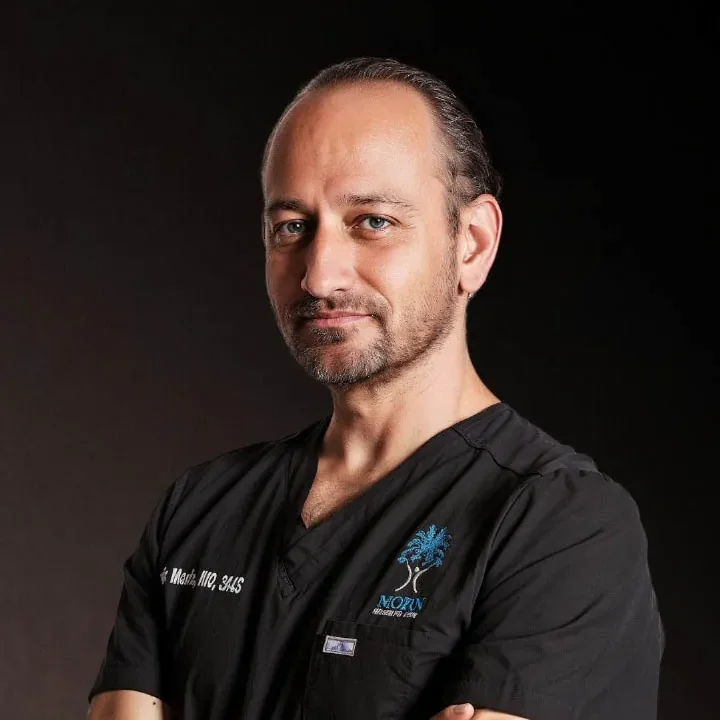
Dr.Babak Moeinolmolki
LA Cosmetic Surgeon Dr. Moein is board-certified by the American Board of General Surgery.