


Table of Contents
For a lot of men, the biggest barrier to fixing their chest isn’t the surgery — it’s the anesthesia. They’ve read about general anesthesia, decided it’s not for them, and quietly shelved the whole idea. Which is why one of the most useful conversations in my Los Angeles practice starts with a fact most patients don’t know: many gynecomastia cases can be done fully awake, under local anesthesia, with you chatting through the procedure and walking out under an hour after we finish. Here’s how awake gynecomastia surgery actually works, who it suits, and where its limits are.
How Awake Gynecomastia Surgery Works
The technique that makes it possible is tumescent local anesthesia. I infiltrate the chest with a large volume of very dilute lidocaine and epinephrine solution, which does three jobs at once: it numbs the entire surgical field completely, it constricts blood vessels so bleeding and bruising drop dramatically, and it firms the tissue plane so the fat separates cleanly. Once the chest is fully numb — we test before anything starts — I perform awake gynecomastia surgery the same way I would asleep: VASER liposuction of the fatty component and, in appropriate cases, direct gland excision through a small incision at the lower border of the areola. Most patients take an oral relaxant beforehand, listen to music, and describe the sensation as pressure and movement — odd, not painful.
Awake vs. General Anesthesia: The Honest Comparison
| Awake (tumescent local) | General anesthesia | |
|---|---|---|
| Best for | Grade 1–2 chests, fat-dominant or moderate gland | Larger corrections, skin excision, grade 3–4 |
| Anesthesia risks | Minimal — no airway management, no intubation | Low but real: airway, nausea, grogginess |
| Recovery start | Walk out ~30–60 minutes after finishing | 1–2 hours in recovery, groggy day |
| Post-op nausea | Rare | Common for the first 24 hours |
| Typical LA cost (2026) | $6,500–$9,500 | $8,000–$12,000+ |
| Extent of correction | Excellent within its lane | Unlimited — full skin work possible |
Who Qualifies for the Awake Approach
Candidacy is anatomical and temperamental in equal measure. Anatomically, the awake approach shines for grade 1 and 2 gynecomastia — a fat-dominant chest or a moderate glandular disc with good skin elasticity, where the operation is VASER lipo plus a contained excision. It is the wrong tool for grade 3–4 chests needing significant skin removal or nipple repositioning; that work takes longer, covers more territory, and belongs under general anesthesia at my full gynecomastia surgery practice. Temperamentally, you need to be comfortable being present: awake surgery is calm and conversational, but it isn’t for the man who would rather know nothing until it’s over — and that preference is completely legitimate. I offer both pathways precisely because patients differ.
Why Men Choose It: Safety, Recovery, and Cost
Three honest advantages. Anesthesia risk profile: skipping general anesthesia means no airway instrumentation and no systemic anesthetic load — meaningful for healthy men and more so for those with sleep apnea or anesthesia anxiety. Complication data for gynecomastia correction is reassuring under either approach, per the NIH’s StatPearls review of gynecomastia, but the simplest anesthetic that accomplishes the operation is a sound default. Recovery: no grogginess, no anesthesia nausea, home the same hour — the rest of recovery (compression vest, gym timeline) matches standard aftercare. Cost: removing the anesthesiologist and shortening facility time typically saves $1,500–$3,000 versus the equivalent case asleep; my gynecomastia surgery cost page breaks down current all-in ranges. The same awake tumescent logic powers smaller-area body work at our sister practice, Awake Lipo Centers — the technique is proven well beyond the chest.
What It Actually Feels Like, Start to Finish
Patients deserve the play-by-play. The only genuinely uncomfortable part is the first minute of numbing injections — a stinging that fades as the solution spreads. The tumescent infiltration itself feels like cold pressure. During VASER and suction you’ll feel vibration, tugging, and movement, and hear the machines; men routinely talk with me, scroll their phone, or zone out to a playlist. If any spot registers as sharp, you say so and I reinforce the numbing on the spot — being awake means real-time feedback, which is a safety feature, not a compromise. Afterward you stand up, get into your compression vest, and walk to the car. The American Society of Plastic Surgeons notes gynecomastia correction may be performed under local or general anesthesia — the technique isn’t fringe; matching it to the right chest is the skill.
Frequently Asked Questions
Does awake gynecomastia surgery hurt?
The numbing injections sting briefly; after that, the chest is completely anesthetized and patients feel pressure, vibration, and tugging rather than pain. If any area registers as sharp during surgery, additional local anesthetic is added immediately.
Can the gland be removed while awake, or only fat?
Both, in appropriately selected cases. Tumescent anesthesia numbs the gland as well as the fat, so a moderate glandular disc can be excised through a periareolar incision awake. Very large glands or cases needing skin excision are better served under general anesthesia.
How much does awake gynecomastia surgery cost in Los Angeles?
Typically $6,500–$9,500 all-in at accredited Los Angeles facilities in 2026 — usually $1,500–$3,000 less than the same correction under general anesthesia, because there’s no anesthesiologist fee and less facility time.
Is awake surgery safer than general anesthesia?
It removes the risks specific to general anesthesia — airway management, systemic anesthetic effects, post-anesthesia nausea — which makes it attractive for men with sleep apnea or anesthesia concerns. Surgical risks like bleeding or seroma remain the same and depend on surgeon and facility quality.
Who is not a candidate for awake gynecomastia surgery?
Men with grade 3–4 gynecomastia needing significant skin removal or nipple repositioning, those with very large glandular components, and anyone who simply prefers to be asleep. For those cases, general anesthesia is the better and safer choice.
Is the recovery different after awake surgery?
The first day is noticeably easier — no grogginess or anesthesia nausea, and you’re home within the hour. From there, recovery follows the standard course: compression vest for several weeks, desk work within about a week, and full chest training at four to six weeks.
The Bottom Line
Awake gynecomastia surgery is the right operation for a specific, common patient: grade 1–2 chest, good skin, and either a preference for staying out of general anesthesia or a budget that appreciates skipping it. It is not a lesser version of the surgery — within its lane, the result is identical, and the day itself is easier. Whether your chest fits that lane takes one examination to answer: book a confidential consultation or call (310) 455-8020.
* Illustrative images on this page are models, not actual patients. Real patient results are shown in our Before & After gallery.
A Note About Pricing You See Online
National-average figures quoted in articles — including some on this site — are typically bare-bones estimates: the surgeon's fee alone. They usually exclude the operating facility, anesthesia, pre-op preparation, and aftercare, and they average in every market and every level of experience nationwide.
At Gynecomastia Centers of Los Angeles, your quote is all-inclusive: pre-operative preparation and clearance, the accredited surgical facility, anesthesia, every post-operative follow-up visit, and our scar-management program — performed personally by a double board-certified surgeon in Los Angeles. One price, no surprise add-ons.
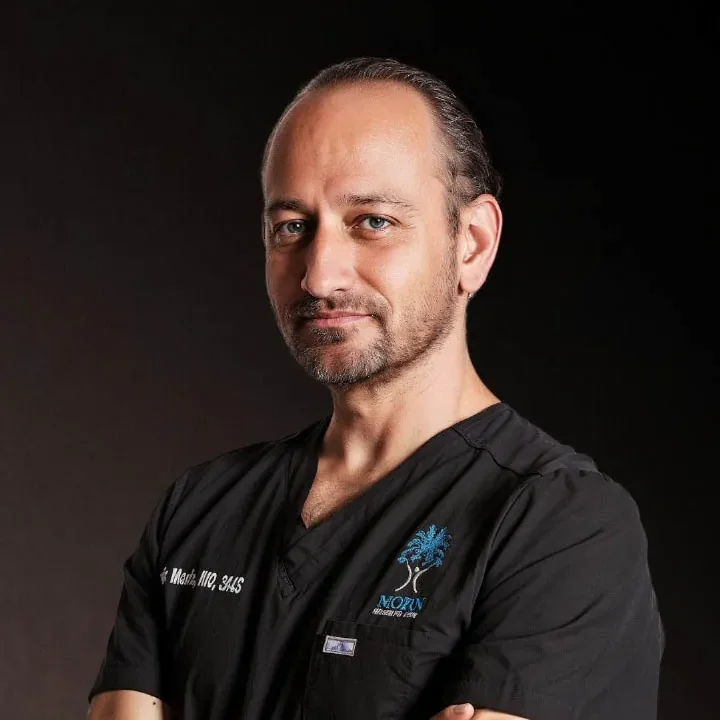
Dr.Babak Moeinolmolki
LA Cosmetic Surgeon Dr. Moein is board-certified by the American Board of General Surgery.