


Table of Contents
- Why Gynecomastia Persists Into Your 20s
- The Emotional Weight of Gynecomastia in Your 20s
- Why Your 20s Are the Best Time for Surgery
- Common Concerns for Men in Their 20s
- Can You Fix Gynecomastia Without Surgery in Your 20s?
- What Surgery Looks Like for a Patient in Their 20s
- The Conversation You Should Have With Yourself
- Frequently Asked Questions
You are in your 20s, and you still have gynecomastia. Maybe it started when you were 13 or 14, during the hormonal turbulence of puberty. Someone, probably your doctor or a parent, told you it would go away on its own. And for about 90 percent of boys who develop pubertal gynecomastia, that turns out to be true. The hormones level out, the breast tissue regresses, and the problem resolves without any treatment.
But you are reading this page because you are in the other 10 percent. The tissue did not go away. You are now 20, 22, 25, maybe 28, and the condition that was supposed to be temporary has become a permanent fixture of your body. I want to explain why that happened, why it will not change on its own at this point, and why your 20s are actually the best window for treating it.
I am Dr. Babak Moeinolmolki, dual board-certified by the American Board of Cosmetic Surgery (ABCS) and the American Board of General Surgery. Gynecomastia surgery is one of the most common procedures I perform in my Los Angeles practice, and a significant portion of my patients are men in their 20s dealing with exactly this situation.
Why Gynecomastia Persists Into Your 20s
During puberty, a temporary imbalance between estrogen and testosterone can stimulate the growth of breast tissue in boys. In most cases, the tissue is soft, composed of proliferating glandular cells, and responsive to hormonal changes. As testosterone levels rise and stabilize, the breast tissue breaks down and disappears.
When this regression does not happen within about two to three years, the glandular tissue begins to change. The cells become fibrotic. Think of it like soft clay that has been left out too long and hardened. Once the tissue has fibrosed, it is no longer responsive to hormonal fluctuations. It is now a permanent structural feature of your chest.
This is why the advice to “wait it out” stops being useful after a certain point. If you are 20 or older and you have had gynecomastia since puberty, the tissue has almost certainly undergone fibrotic changes. Spontaneous resolution at this stage is extremely unlikely. The tissue is not going anywhere without intervention.
The Emotional Weight of Gynecomastia in Your 20s
I want to address something that does not get enough attention in medical discussions of this condition. Gynecomastia in your 20s is not just a cosmetic issue. It affects how you move through the world during a decade that is supposed to be defined by freedom, confidence, and new experiences.
Men in their 20s tell me about avoiding the beach, the pool, and the gym. They describe layering shirts to hide their chest or standing with their arms crossed in photos. Some have turned down dates because they cannot imagine the moment when they would have to take their shirt off. Others tell me they avoid certain jobs or social situations because the self-consciousness follows them everywhere.
These are real consequences that affect quality of life, relationships, career confidence, and mental health. I mention them not to be dramatic but because patients sometimes feel they need to justify wanting surgery for a condition that is “just cosmetic.” If gynecomastia is affecting how you live your life, that is reason enough to address it.
Why Your 20s Are the Best Time for Surgery
If you have decided to pursue gynecomastia surgery, your 20s offer several advantages that you may not have later in life.
Skin elasticity. Your skin is at or near its peak ability to retract and conform to a new contour. After tissue is removed, younger skin bounces back more completely than older skin. This means a lower chance of needing skin excision or additional tightening procedures. Many of my patients in their 20s achieve excellent results with liposuction and gland excision alone, without any skin removal.
Healing speed. Younger bodies heal faster. The surgical sites close more quickly, bruising resolves sooner, and scar tissue remodels more efficiently. Most of my patients in their 20s are back to their normal routine within a week.
Decades of benefit. If you have surgery at 23, you have 50 or more years of living without gynecomastia ahead of you. The cost of the procedure, when measured against the years of improved quality of life, becomes very reasonable.
Physical activity tolerance. Recovery involves some restrictions on exercise and heavy lifting for a few weeks. Younger patients generally tolerate these restrictions well and bounce back to their full activity level quickly.
Common Concerns for Men in Their 20s
Cost
This is the number one concern I hear from patients in their 20s, and it is completely understandable. You may be in school, early in your career, or managing student loans. Gynecomastia surgery is an investment. The cost of gynecomastia surgery in Los Angeles depends on the complexity of your case, but I offer financing options that break the total into manageable monthly payments. Many patients are surprised at how affordable it becomes when spread over time.
Time Off Work or School
Most of my gynecomastia patients return to desk work or classes within three to five days. If your job involves physical labor or heavy lifting, plan for about two weeks before returning to full duties. The surgery itself takes one to three hours depending on the approach, and you go home the same day.
Will It Come Back?
This is a fair question given that the condition already “tricked” you once by not going away when it was supposed to. The recurrence rate after proper surgical excision of the glandular tissue is under 5 percent. The glandular tissue, once removed, does not grow back. The small recurrence risk is mainly associated with weight gain, anabolic steroid use, or certain medications that can stimulate new breast tissue growth. If you maintain a stable weight and avoid these triggers, the result is permanent.
Scarring
Incisions for gynecomastia surgery are made around the lower edge of the areola (the periareolar approach). On younger skin, these scars heal remarkably well. Within six to twelve months, most patients report that the scars are barely visible. The color contrast between the areola and the surrounding skin naturally camouflages the incision line.
Can You Fix Gynecomastia Without Surgery in Your 20s?
I get asked this at almost every consultation, so let me be direct.
Medications. Tamoxifen and raloxifene are selective estrogen receptor modulators that have shown some benefit for gynecomastia. But here is the catch: they work best on soft, recently developed glandular tissue that is still hormonally responsive. If your gynecomastia started during puberty and you are now in your 20s, the tissue has likely fibrosed. Medications at this stage are very unlikely to produce a meaningful reduction. I do not recommend them for long-standing gynecomastia because the evidence for benefit is weak and the side-effect profile is not trivial.
Exercise. You cannot exercise away glandular tissue. Chest exercises like bench press and push-ups build the pectoral muscle underneath the breast tissue, which can actually make the chest look bigger, not flatter. Exercise is excellent for your health and can reduce overall body fat, which helps with pseudogynecomastia (chest enlargement from fat alone). But true gynecomastia with a glandular component will not respond to any amount of time in the gym.
Weight loss. Losing weight can improve the appearance of pseudogynecomastia, and I always encourage patients who are overweight to optimize their weight before surgery. However, weight loss will not eliminate glandular breast tissue. If you have true gynecomastia that has persisted since puberty, losing 20 pounds might improve your overall body composition but your chest will still show the telltale fullness and projection of the glandular tissue underneath.
What Surgery Looks Like for a Patient in Their 20s
A typical gynecomastia surgery for a patient in their 20s involves VASER liposuction of the chest to remove excess fat, direct excision of the glandular tissue through a periareolar incision, and occasionally Renuvion skin tightening if there is moderate skin laxity (though this is less common in younger patients).
The procedure is performed as an outpatient surgery. You arrive in the morning, have the procedure, and go home the same day with a compression garment. Pain is usually mild and well-controlled with prescribed medication. Most patients describe the discomfort as more of an ache or tightness than sharp pain.
At your first follow-up visit, usually within a week, I check the incision sites and your overall healing. You will notice an immediate improvement in chest contour, even with the post-surgical swelling. The final result takes three to six months to fully materialize as swelling resolves and the tissue settles.
The Conversation You Should Have With Yourself
If you have been dealing with gynecomastia for years, you have probably developed coping mechanisms. You know which shirts hide it best. You know how to position yourself in photos. You have gotten used to declining invitations that involve taking your shirt off. These adaptations become so routine that they start to feel normal.
But they are not normal. You are modifying your behavior around a treatable medical condition. The question is not whether you can keep managing it. You have already proven that you can. The question is whether you want to keep managing it for the next several decades, or whether you want to address it once and move on with your life.
If you are ready to explore your options, I offer consultations at my Los Angeles office. You can also learn more about what to expect from surgery on the teen gynecomastia page, since many of those patients share a similar history of onset during puberty.
Frequently Asked Questions
Can gynecomastia go away after age 20?
It is extremely unlikely. By age 20, pubertal gynecomastia that has not resolved on its own has undergone fibrotic changes, meaning the tissue has hardened and is no longer responsive to hormonal fluctuations. Spontaneous resolution after this point is rare enough that surgery is the recommended treatment.
What is the best age to get gynecomastia surgery?
The 20s are an excellent window. Skin elasticity is high, healing is fast, and the surgery provides decades of benefit. That said, there is no upper age limit for the procedure. I have operated on men in their 60s with great results. The best age is whenever the condition bothers you enough to seek treatment.
How long is recovery from gynecomastia surgery?
Most patients in their 20s return to desk work or school within three to five days. Light exercise can resume at about two weeks. Full gym activity, including chest exercises, is typically cleared at four to six weeks. The chest continues to improve in appearance for three to six months as swelling resolves.
Will insurance cover gynecomastia surgery?
Most insurance plans consider gynecomastia surgery cosmetic and do not cover it. There are occasional exceptions for severe cases with documented symptoms, but coverage is not the norm. Financing options are available to make the procedure affordable on a monthly payment plan.
Can gynecomastia come back after surgery in your 20s?
The recurrence rate after complete glandular excision is under 5 percent. The removed tissue does not regenerate. Recurrence risk is mainly associated with significant weight gain, anabolic steroid use, or medications that stimulate breast tissue growth. Avoiding these triggers makes the result essentially permanent.
Should I lose weight before gynecomastia surgery?
If you are significantly overweight, losing weight before surgery can improve your results by reducing the fatty component and allowing the surgeon to better define the chest contour. However, do not delay surgery indefinitely to reach a “perfect” weight. I can work with patients at a range of body types, and the glandular component will not change regardless of weight loss.
* Illustrative images on this page are models, not actual patients. Real patient results are shown in our Before & After gallery.
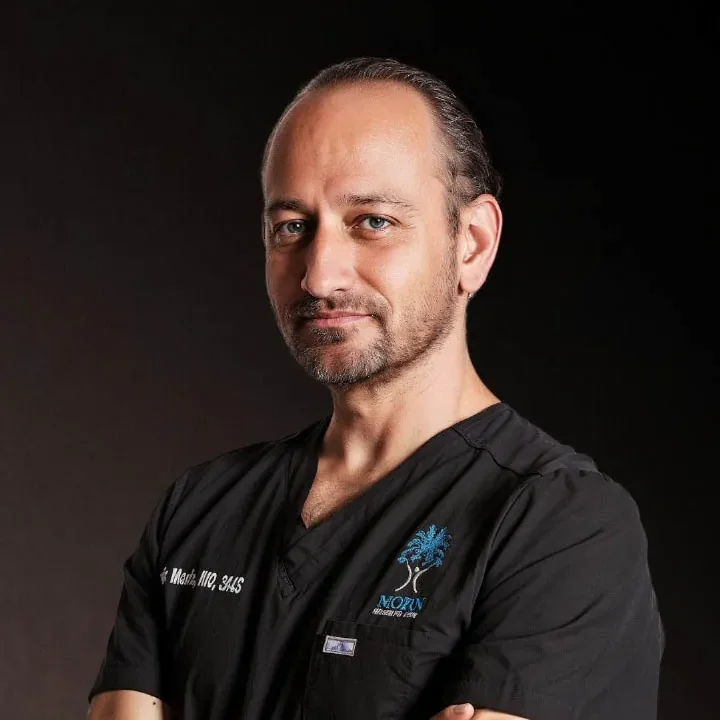
Dr.Babak Moeinolmolki
LA Cosmetic Surgeon Dr. Moein is board-certified by the American Board of General Surgery.