


Table of Contents
What Is Mondor’s Cord?
A few weeks after gynecomastia surgery, some patients notice something alarming: a hard, rope-like structure under the skin of the chest. It might run horizontally across the chest wall or extend from the armpit toward the nipple. It feels like a cord or a thin cable buried just beneath the surface. Pressing on it can be tender, and the surrounding skin might feel tight when you stretch your arm overhead.
This is Mondor’s cord, also known as Mondor’s disease. The name sounds more frightening than the condition actually warrants. Mondor’s cord is superficial thrombophlebitis of a vein in the chest wall. In simpler terms, a vein near the surface of the skin develops a small blood clot and becomes inflamed. The vein hardens, and you can feel it through the skin as a distinct linear structure.
Henri Mondor, a French surgeon, first described this condition in 1939. While it can occur spontaneously, it has a well-documented association with breast and chest surgery. I want patients to understand that Mondor’s cord, while uncomfortable and sometimes worrying, follows a predictable course and resolves on its own in the vast majority of cases.
Why Mondor’s Cord Happens After Gynecomastia Surgery
Gynecomastia surgery typically involves liposuction, direct excision of glandular tissue, or a combination of both. During liposuction, a cannula moves back and forth through the tissue layer beneath the skin, breaking up and removing fat. This process is effective at contouring the chest, but it also creates some degree of trauma to the small blood vessels in the area.
Superficial veins running along the chest wall are particularly vulnerable. The thoracoepigastric vein and the lateral thoracic vein are the ones most commonly affected. When the cannula passes near these vessels, it can damage the vein wall. The body responds by forming a localized blood clot inside the vein, which then becomes inflamed. The result is the characteristic firm, cord-like structure that patients can feel and sometimes see.
Direct tissue excision around the areola can also contribute. The surgical manipulation required to remove dense glandular tissue involves retraction and dissection that may irritate or compress nearby veins. Compression garments worn during recovery, while necessary and beneficial for overall healing, can occasionally contribute to venous stasis in superficial vessels.
It is worth noting that Mondor’s cord after surgery is not a sign of poor technique. It reflects the normal variability of individual anatomy and healing responses. Some patients have more prominent superficial veins or a greater tendency toward clotting in small vessels.
How Common Is Mondor’s Cord After Gynecomastia Surgery?
Published literature suggests Mondor’s cord occurs in roughly 1 to 3 percent of patients following chest or breast surgery. The exact incidence after gynecomastia surgery specifically is harder to pin down because many mild cases go unreported. A patient might notice a firm area under the skin, assume it is normal post-surgical healing, and never mention it at a follow-up appointment.
In my practice, I see Mondor’s cord in a small but consistent percentage of gynecomastia patients. It tends to appear more frequently in patients who had extensive liposuction, particularly when larger volumes of tissue were removed or when the treatment area extended into the lateral chest wall and axillary region. Patients with a history of longer recovery periods or those who are less mobile in the early days after surgery may also be at slightly higher risk, possibly because reduced movement allows blood to pool in superficial veins.
A study published on PubMed examining Mondor’s disease after breast procedures confirmed that the condition is benign and self-limited in nearly all surgical cases. The key takeaway from the medical literature is consistent: Mondor’s cord is uncomfortable but not dangerous.
Symptoms and Timeline
Mondor’s cord typically appears one to four weeks after surgery. Most patients first notice it around the two-week mark, though some don’t become aware of it until three or four weeks post-op when swelling has decreased enough for the cord to become palpable.
The symptoms include:
A firm, linear structure under the skin that feels like a cord, rope, or thick string. It usually runs in a relatively straight line, often horizontally across the chest or diagonally from the armpit area toward the sternum.
Tenderness or pain along the length of the cord, especially when touched or when the arm on the affected side is raised overhead. The pain ranges from mild to moderate. Some patients describe it as a pulling or tugging sensation rather than sharp pain.
Skin tethering or dimpling along the cord when the arm is extended. This happens because the inflamed vein adheres to the overlying skin, creating a visible indentation that follows the path of the vessel.
The affected area may feel warm to the touch, though significant redness or spreading warmth would warrant prompt medical evaluation, as those signs could indicate a different problem. Mondor’s cord itself does not cause fever, widespread redness, or systemic symptoms.
Treatment and Management
The good news about Mondor’s cord is that it almost always resolves without any specific medical intervention. The typical timeline for complete resolution is four to eight weeks, though some patients notice improvement sooner and others take a bit longer. Here is what helps during the healing process.
Warm compresses applied to the affected area for 15 to 20 minutes several times daily can provide relief. The warmth improves local blood flow and helps reduce inflammation. Use a warm (not hot) towel or heating pad set to a low temperature.
Anti-inflammatory medications such as ibuprofen (Advil, Motrin) or naproxen (Aleve), taken as directed on the packaging, can reduce both pain and inflammation. If you are already taking other post-operative medications, check with your surgeon before adding an NSAID to make sure there are no interactions.
Gentle massage along the cord, once your surgeon clears you for it, can help break up the clot and reduce skin tethering. I generally advise patients to wait until the initial tenderness has subsided before beginning massage, usually around two to three weeks after the cord first appears.
Continued use of the compression garment as directed in your aftercare instructions remains important for overall recovery, even with Mondor’s cord present. Gentle arm stretches and normal daily movement (avoiding heavy lifting per your surgeon’s post-op restrictions) help prevent stiffness and promote circulation.
When Should You Be Concerned?
While Mondor’s cord itself is benign, certain symptoms accompanying the cord should prompt you to contact your surgeon promptly. These include:
Redness and warmth that spread outward from the cord into the surrounding skin. Mondor’s cord causes localized inflammation, not expanding redness. Spreading redness could indicate cellulitis or another type of infection.
Fever above 100.4 degrees Fahrenheit. Mondor’s cord does not cause systemic fever. Fever after any surgery needs evaluation.
The cord extending deeper into the tissue or the development of a swollen, painful lump that does not follow a linear pattern. Deep vein thrombosis, while extremely rare in this context, requires different treatment than superficial thrombophlebitis.
Increasing pain that does not improve with over-the-counter anti-inflammatory medication, or pain that worsens significantly after initially improving.
If you are wondering whether your symptoms are within the range of normal post-surgical healing, the safest course of action is always to reach out to your surgeon’s office. A quick phone call or photo sent through a patient portal can often provide reassurance without requiring an extra office visit.
Dr. Babak Moeinolmolki’s Approach
In my consultations before gynecomastia surgery, I make a point of discussing Mondor’s cord as one of the possible post-operative occurrences. I have found that patients who know about the possibility ahead of time handle it much better if it develops. The anxiety of discovering an unexpected hard lump under the skin after chest surgery is understandable, and pre-operative education eliminates most of that worry.
I am certified by both the American Board of Cosmetic Surgery and the American Board of General Surgery. This dual training means I approach post-operative complications with both a cosmetic surgeon’s attention to aesthetic outcomes and a general surgeon’s understanding of vascular and tissue healing. Mondor’s cord sits squarely at that intersection.
During follow-up appointments, I examine any reported cords to confirm the diagnosis and rule out other causes. I document the location, length, and tenderness of the cord and track its resolution over subsequent visits. In the rare case where a Mondor’s cord persists beyond the typical timeline, additional evaluation may be warranted, but I have not needed to pursue aggressive treatment for this condition in my practice.
My patients receive detailed written post-operative guidelines that include information about Mondor’s cord, along with clear instructions about what symptoms require a phone call and what can wait until the next scheduled follow-up. This approach keeps patients informed and reduces unnecessary emergency visits while ensuring that genuine concerns receive prompt attention.
The Bottom Line
Mondor’s cord after gynecomastia surgery is an uncommon but well-recognized post-operative finding. It is not a complication that reflects surgical error. It is a predictable response that occurs in a small percentage of patients when superficial veins are affected by the normal surgical process. The cord looks and feels alarming, but it resolves on its own within weeks. Simple measures like warm compresses, anti-inflammatory medication, and gentle massage support healing and provide comfort during the process.
If you develop what you suspect is Mondor’s cord after your procedure, take a breath. Note the location and how it feels, and mention it to your surgeon at your next follow-up. Unless you have spreading redness, fever, or worsening pain, it is overwhelmingly likely that the cord will fade without any intervention beyond patience.
Frequently Asked Questions
What does Mondor’s cord feel like after gynecomastia surgery?
Mondor’s cord feels like a firm, rope-like structure running just beneath the skin of the chest. Most patients describe it as a hard line or cable that you can trace with your finger. It is usually tender when pressed and may cause a pulling sensation when you raise your arm. The cord typically runs horizontally across the chest or from the armpit area toward the nipple.
How long does Mondor’s cord last after chest surgery?
Mondor’s cord generally resolves within four to eight weeks without specific treatment. Some patients notice the cord softening and becoming less noticeable within three weeks, while others may feel a faint cord for up to ten or twelve weeks. The tenderness usually fades before the cord itself fully disappears.
Can Mondor’s cord be prevented during gynecomastia surgery?
There is no reliable way to completely prevent Mondor’s cord because it depends on individual anatomy and healing responses. Surgeons can minimize the risk by using careful technique during liposuction and limiting unnecessary trauma to the lateral chest wall, but the condition occurs even with the most meticulous surgical approach.
Is Mondor’s cord dangerous or a sign of a blood clot?
Mondor’s cord is a superficial blood clot in a small vein near the skin surface. It is not the same as a deep vein thrombosis (DVT), which occurs in larger, deeper veins and can be medically serious. Mondor’s cord does not travel to the lungs or cause pulmonary embolism. It is a localized, self-limited condition.
Should I see my surgeon if I develop Mondor’s cord?
You should mention Mondor’s cord at your next scheduled follow-up appointment so your surgeon can confirm the diagnosis. However, you should contact your surgeon’s office sooner if you notice spreading redness, fever, increasing pain, or swelling that does not follow a linear pattern, as these symptoms may indicate a different condition requiring treatment.
Does Mondor’s cord affect the final results of gynecomastia surgery?
Mondor’s cord does not affect the long-term cosmetic outcome of gynecomastia surgery. Once the cord resolves and the inflammation subsides, the chest contour reflects the surgical result as intended. Any temporary skin tethering or dimpling along the cord disappears as the vein softens and the tissue remodels during the normal healing process.
* Illustrative images on this page are models, not actual patients. Real patient results are shown in our Before & After gallery.
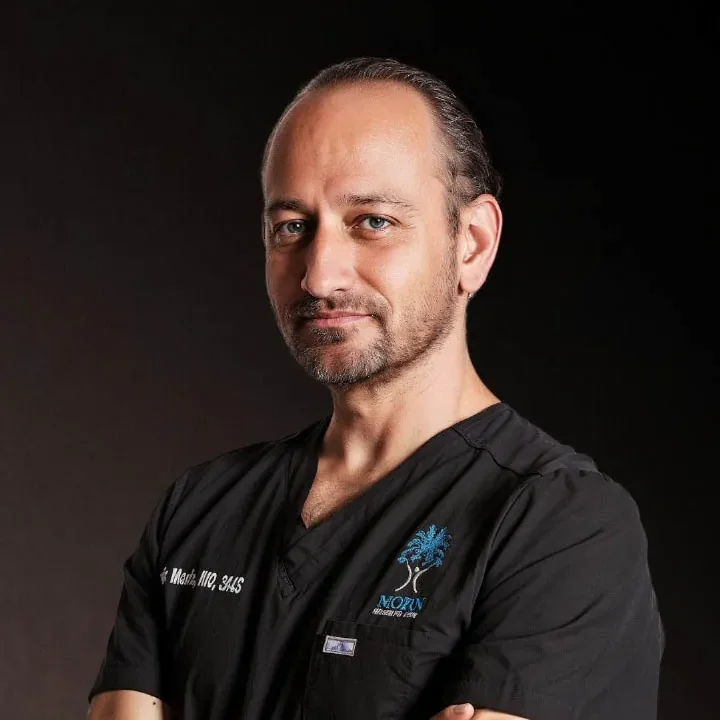
Dr.Babak Moeinolmolki
LA Cosmetic Surgeon Dr. Moein is board-certified by the American Board of General Surgery.