


Table of Contents
- How should you sleep after gynecomastia surgery?
- Why sleeping flat causes problems in the first weeks
- Sleeping position week by week
- When can you sleep on your side after gynecomastia surgery?
- When can you sleep on your stomach?
- Practical setup that actually works
- Does poor sleep positioning affect the result?
- Do not confuse rest with immobility
- Sleep problems worth calling about
- The bottom line
- About the surgeon
You sleep on your back, propped up at roughly thirty to forty-five degrees, in your compression vest, for the first two to three weeks after gynecomastia surgery. That is the short answer, and most men manage it with a wedge pillow or a recliner rather than a stack of regular pillows that collapses by 3 a.m.
Sleep is the part of recovery patients underestimate. Nobody warns you that the position you have used every night for thirty years is off the table, or that the first three nights are the hardest part of the entire operation for a lot of men. Here is how to set it up so you actually rest.
How should you sleep after gynecomastia surgery?
Sleep on your back with your upper body elevated thirty to forty-five degrees for the first two to three weeks after gynecomastia surgery. Keep the compression vest on overnight. Elevation limits swelling in the chest, back-sleeping avoids pressure on healing tissue, and the vest maintains contact between skin and chest wall while the space closes.
The elevation matters more than most men expect. Lying flat lets fluid settle into the operated chest overnight, and you wake up tighter, more swollen, and more uncomfortable than you went to bed. Patients who hold the angle consistently through the first two weeks report a noticeably smoother swelling curve than those who slide down flat halfway through the night.
Why sleeping flat causes problems in the first weeks
Gynecomastia surgery leaves a potential space where gland and fat used to sit. The body fills that space with fluid until the skin adheres back down to the chest wall. Everything about the early protocol, the vest included, exists to keep that space small and to keep fluid moving out of it rather than pooling.
Gravity is doing real work here. Flat on your back, the chest sits at the same level as the heart and drainage slows. Propped at thirty degrees or more, fluid moves away from the chest through the night instead of collecting. That is the same reasoning behind keeping the vest on around the clock, covered in more detail in the guide to the compression vest after gynecomastia surgery.
Rolling onto your side or stomach adds a second problem. Direct pressure on a healing chest shears the skin against the chest wall at exactly the plane you want to stay still. That mechanical disruption is one of the contributors to a seroma after gynecomastia surgery, and it is avoidable.
Sleeping position week by week
Timelines vary with how much tissue was removed and whether gland excision was combined with liposuction. Use this as the default and follow whatever your surgeon specifies for your case.
| Time after surgery | Sleeping position | Vest |
|---|---|---|
| Nights 1 to 7 | Back only, elevated 30 to 45 degrees. Recliner or wedge. | On, continuously |
| Weeks 2 to 3 | Back, elevation can ease toward 20 to 30 degrees as swelling settles | On overnight |
| Weeks 3 to 4 | Most men are cleared to sleep flat on the back. Brief side positions often permitted. | Per surgeon instruction |
| Weeks 4 to 6 | Side sleeping generally comfortable. Stomach still discouraged. | Often tapering |
| After week 6 | Stomach sleeping usually cleared once swelling and tenderness resolve | Typically done |
When can you sleep on your side after gynecomastia surgery?
Most men return to side sleeping around week four, and comfortably by week six. The limiting factor is tenderness rather than tissue safety by that point. If rolling onto your side wakes you with a pulling sensation across the chest, the tissue is telling you it is early, and another week usually settles it.
Men who had a larger gland excision or who developed significant swelling tend to run at the later end of that range. Age matters as well, and the tissue differences behind that are covered in the discussion of gynecomastia surgery over 40.
When can you sleep on your stomach?
Stomach sleeping is the last position to come back, usually around six weeks and sometimes later. It places the most direct and sustained pressure on the chest of any position, and it compresses tissue that is still remodeling underneath. There is no benefit to rushing it and a real, if small, risk of provoking swelling that had already settled.
Habitual stomach sleepers have the hardest recovery on this front. A body pillow along one side gives you something to brace against and makes back sleeping considerably easier to hold through the night.
Practical setup that actually works
A recliner is the single most effective piece of equipment for the first week, and men who have access to one almost always end up using it. If you do not have one, a foam wedge pillow holds an angle that stacked pillows will not. Regular pillows compress and slide, and you end up flat without noticing.
A few things worth arranging before surgery day. Put water, phone, and medication within arm’s reach so you are not twisting or reaching overhead at 2 a.m. Wear a loose button-front shirt rather than anything pulled over the head. Set an alarm for the first two nights if you are on a scheduled pain medication, because staying ahead of pain is what lets you sleep at all in that window.
Getting out of bed has its own technique. Roll to one side keeping the trunk in a single unit, drop the legs off the edge, and push up with the arm underneath. Do not sit straight up using chest and abdominal muscles. That movement pulls directly on the healing plane.
Does poor sleep positioning affect the result?
It can. Consistent elevation and vest wear through the first weeks reduce fluid accumulation, and fluid accumulation is what drives the complications that change a result. A seroma that organizes into a fibrous pocket can leave a palpable firmness or a contour irregularity that needs a revision to correct. The NIH StatPearls review of gynecomastia lists seroma and hematoma among the recognized complications of male breast reduction.
None of this means a single night of sliding flat has ruined anything. It means the protocol has a purpose, and the men who follow it closely for three weeks tend to have the least eventful recoveries.
Do not confuse rest with immobility
Sleeping propped up is not permission to stay in the chair all day. Short, frequent walks starting the day of surgery are part of the protocol, and they matter for circulation. Body contouring procedures carry a measurable, if low, thromboembolic risk, and early ambulation is one of the standard mitigations, as reviewed in the analysis of thromboembolism risk after body contouring surgery.
Walk every hour or two while you are awake. Keep it gentle and short. The rest of the activity progression is laid out in the week-by-week gynecomastia recovery timeline.
Sleep problems worth calling about
Ordinary first-week sleep is broken, uncomfortable, and improves every few nights. Certain patterns point elsewhere.
Call the office for pain that climbs rather than falls after day three, for one side that swells noticeably more than the other overnight, for fever, or for spreading redness. Calf pain or shortness of breath warrants same-day evaluation. Numbness and odd tingling that disrupt sleep are usually nerve recovery rather than a problem, and that pattern is described in detail under numbness after gynecomastia surgery.
The bottom line
Back, elevated, vest on, for two to three weeks. Side sleeping around week four, stomach around week six. Buy or borrow a wedge before surgery day rather than improvising with pillows at midnight. Full pre-operative and aftercare detail is on the gynecomastia aftercare instructions page.
If you are still weighing whether surgery is the right step, or you want your specific anatomy assessed before you plan time off, a consultation is the place to start. Men looking for a male-focused surgical practice can also review options through XY Sculpt.
About the surgeon
Dr. Babak Moeinolmolki, MD, FACS is double board-certified through the American Board of Surgery and the American Board of Cosmetic Surgery (ABCS), and practices in Los Angeles with a focus on male chest contouring. When evaluating any surgeon for this procedure, verify certification directly with the certifying board listed on their profile, and ask specifically how many male breast reductions the surgeon performs each year.
* Illustrative images on this page are models, not actual patients. Real patient results are shown in our Before & After gallery.
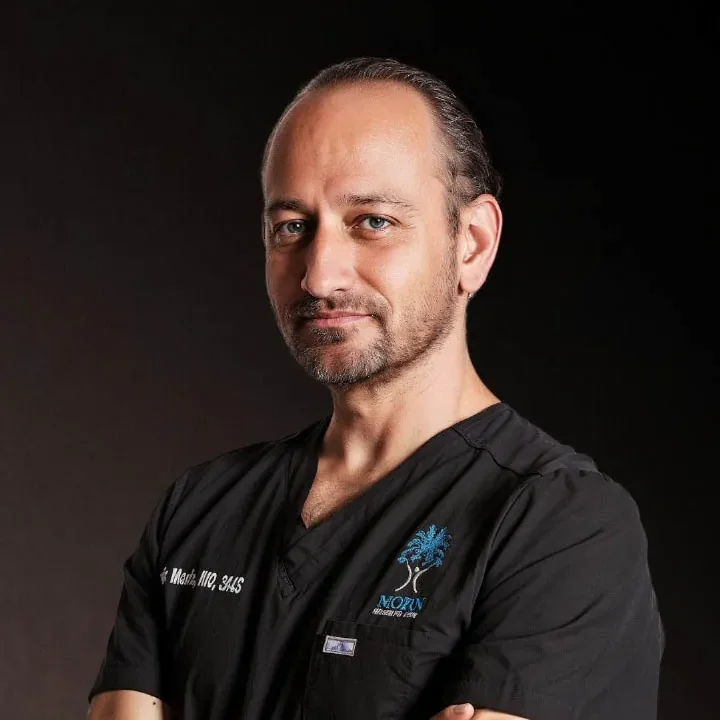
Dr.Babak Moeinolmolki
LA Cosmetic Surgeon Dr. Moein is board-certified by the American Board of General Surgery.